

Legend has it that eons ago, the Kathmandu valley was a lake. There is geological evidence to support this. During that far off period, a hill arose from those waters all by itself, so was therefore regarded with awe by the local residents around the lake. Eons later, the water drained away from the valley, leaving it clear to become populated; in this way Kathmandu was built.
But that hill remained sacred, so attracted the erecting of shrines and stupas, (places of prayer) by the citizens of Kathmandu. The name given to this ssacred place was derived from the local word for self-arisen – swayambhu. The temple today is known as Swayambhunath.
To reach it requires a climb up 365 stone steps that form a stair case facing south, so is out in the sun for many hours of the day. Think before attempting the ascent.
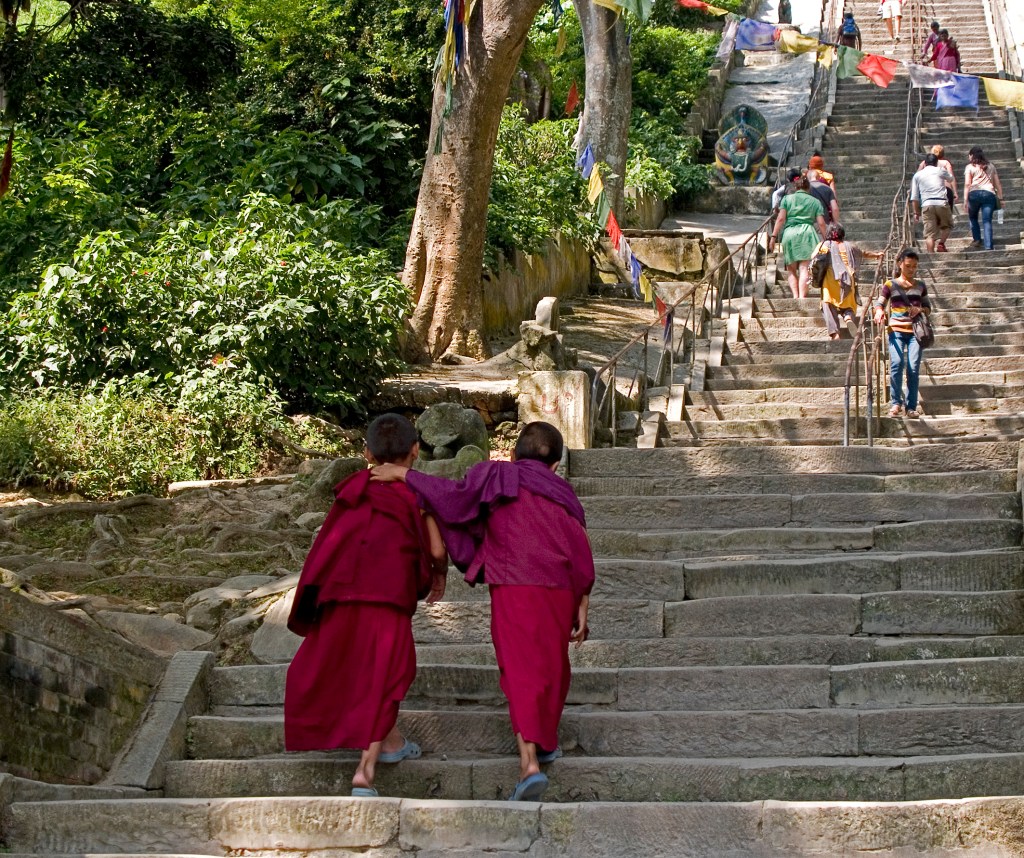
As I was making this climb, these two Buddhist Monks came my way, and greeted me in the traditional namaste manner. I was teaching spoken, basic English at a nearby Monastery – my reason for being in Nepal – and these were two of my pupils. I did not need to teach them courtesy or manners – these they knew already.
Were I to give a tip to potential travellers to Nepal, this one would be my main tip : if you want to meet local people, just sit down in one place, and they will come to you to talk. Their spoken English is acceptable, and conversation is worthwhile.

 Perceptions & Pictures